

Quick Summary
To verify authentic luxury bags, combine several checks rather than relying on one feature. Inspect the logo, stitching, materials, hardware and serial or date code in good daylight, then compare them with the listing and any paperwork. No single check proves a bag is genuine.
- Inspect in clear daylight or bright neutral light, using a magnifier or macro camera.
- Count stitches per inch and look for loose threads, gaps or uneven spacing.
- Test zippers and clasps; a clean click and smooth glide suggest genuine hardware.
- A serial number or date code is a production identifier, not a guarantee of authenticity.
- Consider professional authentication when the price is high or your own check leaves doubts.
Table of Contents
- What You Need Before You Start Checking a Bag
- Step 1: Inspect the Logo and Brand Marks
- Step 2: Check Stitching, Seams and Materials
- Step 3: Examine Hardware, Zippers and Clasps
- Step 4: Read the Serial Number and Date Code
- Step 5: Use the Designer Bag Authenticity Card and Receipts
- Step 6: Work Through a Designer Bag Authenticity Checklist
- When to Book a Luxury Bag Authentication Service
- Frequently Asked Questions
What You Need Before You Start Checking a Bag
Last Updated: October 30, 2026
Checking a luxury bags collection is part detective work and part patience. Before you start, read general guidance on safely buying luxury items online so you know what to look for in the listing and the seller.
Gather a few basic things first. Good lighting matters more than most people expect. A bright window in daylight shows stitching, leather grain and hardware finish far better than a warm indoor lamp.
Keep your expectations realistic. A visual check can catch many fakes, but it is not a guarantee. Counterfeit bags can copy leather, weight, stamps and construction closely enough to fool experienced eyes. That is why the steps below work best as a combined review rather than a single test.
- Clear daylight or a bright, neutral light source
- A magnifying glass or macro camera
- The listing photos and description for comparison
- Any original receipt, dust bag or authenticity card you have
- Time to look slowly, without rushing the decision
Step 1: Inspect the Logo and Brand Marks
The logo is usually the first thing people check on luxury bags, and it is also the easiest thing for counterfeiters to copy. Look at the brand marks closely. Are the letters, monograms or emblems evenly spaced? Are the edges crisp, or do they look blurred, thick or uneven?
Check where the logo sits, too. Placement on the front, back and hardware should match what the brand does on that model. A logo that looks slightly too large, too small or off-center is a warning sign. Compare it side by side with photos of a verified bag of the same style.
Watch out: a perfect logo does not prove a bag is real. Counterfeit sellers have become skilled at copying marks, so treat the logo as one clue among many.
Step 2: Check Stitching, Seams and Materials
Stitching tells you a lot about how a bag was made. Look at the thread count per inch, the color match and the consistency of each stitch. Authentic bags usually have tight, even rows with no loose ends or skipped stitches. Pay attention to corners and handles, where fakes often cut corners.
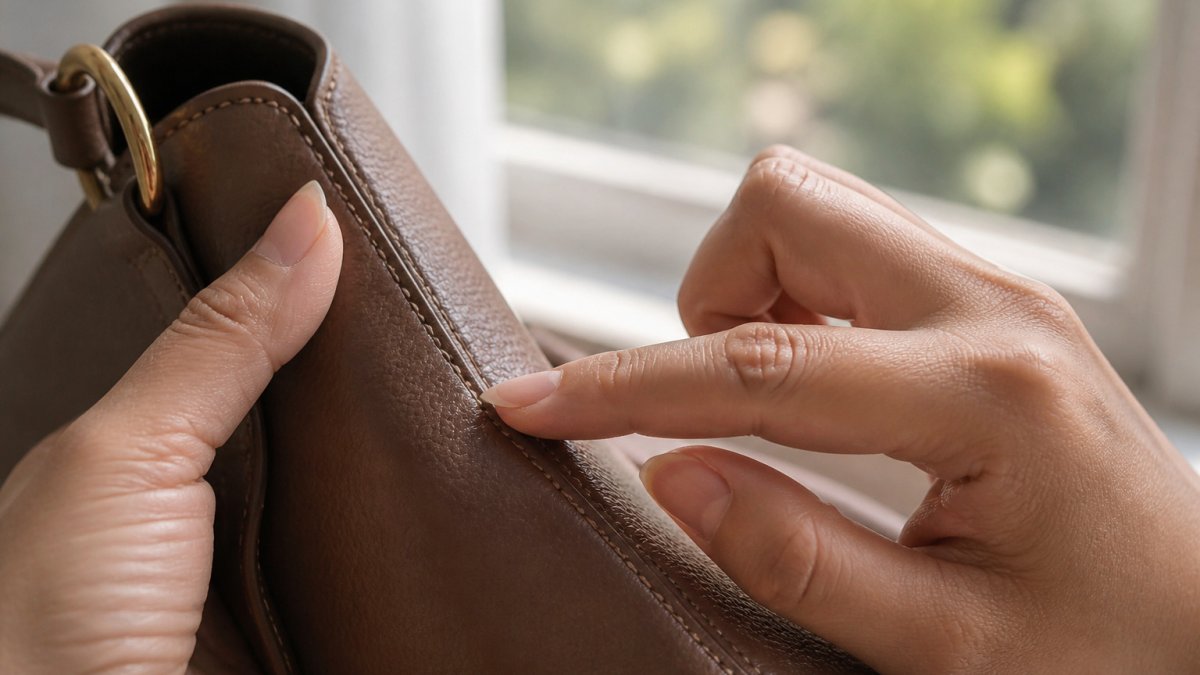
Next, check the materials. Genuine leather has natural grain variation, and the texture should feel consistent across the bag. Run your fingers over the surface. Plastic-like coatings, unnatural shine or a strong chemical smell can signal a counterfeit. The weight can also help. A bag that feels flimsy or unusually light compared to the listing deserves a closer look.
- Count stitches per inch and compare them across the bag
- Look for loose threads, gaps or uneven spacing
- Check leather grain, texture and finish
- Note any unusual smell or stiffness
Step 3: Examine Hardware, Zippers and Clasps
Hardware is hard to fake well, which makes it valuable for verification. Turn the bag over and look at the zippers, clasps, buckles and feet. Genuine hardware usually has a solid, smooth feel and a finish that matches the brand's standard. Engravings should be sharp and clear, not shallow or blurry.
Test the moving parts. A zipper should glide without catching, and a clasp should click cleanly. Many counterfeits use lighter metal or weak mechanisms, so a hardware piece that feels cheap or wobbles is a red flag. Check that the zipper pull and any engraved text are consistent with the style you are looking at.
Step 4: Read the Serial Number and Date Code
Serial numbers, date codes and similar identification marks are among the most misunderstood features on a luxury bag. For a broader view, see sustainable luxury handbag shopping tips when deciding whether a bag is worth verifying or buying.
What a code can tell you:
- Whether the format and placement are consistent with the brand, model and production era
- Whether the code matches the style, hardware and materials of the bag
- Whether the seller's description, receipt or card references the same code
What a code cannot tell you:
- That the bag is genuine. Counterfeiters copy real codes, and codes can be transplanted from one bag to another.
- That the bag was made in a particular country or year unless the brand's own documentation confirms the coding system for that period.
- That the paperwork belongs to the bag. Cards, receipts and codes are frequently separated from the original item.
Codes vary widely by brand and change over time. A format that looks wrong may simply belong to a different production era, and a format that looks right may be a convincing copy.
Where to look: interior tags, stamped leather, hardware engravings, interior pockets and, on some models, the underside of a strap or the edge of a lining seam. Photograph the code straight-on in good light, include a scale reference if possible, and note its exact location.
A practical rule: use the code as one consistency check among many. If the code, stitching, hardware, materials and paperwork all align, your confidence rises. If the code is the only thing that looks right, that is a reason to slow down, not to buy.
The table below summarises what a serial number or date code can and cannot prove.
| Check | Can prove | Cannot prove |
|---|---|---|
| Format and placement | Consistency with brand, model and era | That the bag is genuine |
| Code vs. style and hardware | Whether the code fits the bag's features | That the code was not copied |
| Code vs. seller paperwork | Whether the description references the same code | That the paperwork belongs to the bag |
| Code in isolation | Little on its own | Authenticity by itself |
Step 5: Use the Designer Bag Authenticity Card and Receipts
An authenticity card, certificate or original receipt can add useful context. Look at the card for the same things you check on the bag: print quality, paper feel, spelling and whether the details match the bag's model and serial information. Be cautious with cards that look too new or contain typos.
Receipts are helpful only if the details line up. Check the date, store name, item description and price against the bag. A receipt is not proof by itself, since it can be forged or belong to a different item.
Watch out: a card or receipt sent by a seller is not the same as an independent review. If the paperwork is the only thing supporting the sale, the bag still needs the other checks above.
Step 6: Work Through a Designer Bag Authenticity Checklist
With each step done, bring the findings together. A simple checklist keeps you from skipping details or letting one strong feature hide a weak one. Score each area as consistent, unclear or inconsistent with the brand's known standard.
- Logo and brand marks: even, crisp and correctly placed
- Stitching: tight, consistent and free of loose threads
- Materials: natural grain, correct weight and no strong chemical odor
- Hardware: solid feel, clean engraving and smooth moving parts
- Serial number or date code: format and placement match the era
- Paperwork: card and receipt details line up with the bag
- Seller and listing: photos match the item and the description is clear
If most areas look consistent, the bag is more likely genuine. If several areas look wrong, walk away. One unclear area is worth investigating further before you decide.
When to Book a Luxury Bag Authentication Service
A visual check has real limits. Photos can omit important details, counterfeit quality varies widely, and no single feature proves authenticity. Professional review is worth considering when the stakes are high or when your own inspection leaves you uncertain.
When an in-person or professional review is warranted:
- The purchase price is significant enough that a mistake would be costly
- The seller cannot provide clear, well-lit photos of logos, stitching, hardware, interior labels and codes
- The bag's brand, model or production era is one you do not know well
- Several checklist areas are unclear or inconsistent
- The paperwork is the main thing supporting the sale
- The seller pressures you to decide quickly or discourages inspection
How to evaluate an authentication service:
- Brand and model expertise. Ask whether the reviewer regularly handles your specific brand and model, including the production era of the bag. Generalist services may miss era-specific details.
- Methodology. Ask what they examine, whether they work from photos or in person, and what they do when a detail is ambiguous. A transparent process is a good sign; vague assurances are not.
- Evidence requirements. A serious service will tell you exactly which angles and close-ups it needs. If it accepts a single front photo and promises a verdict, treat that with caution.
- Written findings. Ask whether you receive a written determination that explains the reasoning and notes any limitations. A one-word 'authentic' or 'fake' with no explanation is less useful.
- Turnaround and independence. Confirm how long results take and whether the reviewer is independent of the seller. A service paid or influenced by the seller is not independent.
- Dispute and refund policies. Ask what happens if the bag is later found not authentic, and whether the service offers any recourse or refund policy.
Safe evidence collection for remote review:
If you use a photo-based service, capture a consistent set of images: front, back, both sides, base, top opening, interior lining, interior label, serial or date code, logo close-up, hardware close-up (zippers, clasps, feet), stitching close-up at a seam and corner, and any included card, receipt or dust bag. Use daylight, avoid filters, and keep the camera steady. Protect your personal information by cropping or blurring anything you do not need to share.
Professional review reduces risk, but it is not a guarantee. Use it alongside the checklist above, a careful review of the seller and listing, and protected payment methods. If the seller, the price or the paperwork feels wrong, walk away, no authentication report can fix a bad transaction.
Frequently Asked Questions
How can you tell if a luxury bag is authentic?
Start with the logo, stitching, hardware and interior label, since these are the areas counterfeiters most often get wrong. Compare the bag against verified photos from the same brand and model, and check whether the weight, leather texture and finish feel consistent with what you expect. Visual checks catch many fakes but cannot guarantee authenticity, especially with high-quality counterfeits, so treat a clean inspection as a strong signal rather than proof.
Can an authenticity card prove that a luxury bag is real?
No. An authenticity card, certificate or receipt can be copied, reused or forged, so it should be treated as supporting evidence only. Check that the serial number, date code and card details match the bag itself and that they are consistent with each other. If the card is the only thing that looks right, the bag still needs a full inspection or a professional review before you rely on it.
Are serial numbers or date codes enough to authenticate a designer bag?
Serial numbers and date codes are useful identification marks, but they are not enough on their own. Counterfeiters can copy plausible-looking codes, so check that the format, placement and font match the brand's known examples for that model and era. Combine the code with the logo, stitching, hardware and materials before deciding.
When should you use a professional luxury bag authentication service?
Use a professional authentication service when the purchase is expensive, when you are buying from a private seller or an unfamiliar marketplace, or when the visual checks leave you unsure. Expect to upload clear photos of the logo, interior, hardware, serial number and date code, and check the service's turnaround time and what its determination covers before you pay.
